

aha™: Agentic Harmonization
Assistant
Developed in collaboration with
the AD Data Initiative.
aha™
Harmonization Assistant.
High-quality prediction begins with high-quality data. aha™ automatically harmonizes clinical, imaging, sociodemographic, and multi-omics datasets related to Alzheimer’s disease, transforming heterogeneous cohorts into a unified, reliable dataset ready for advanced analytics and AI-driven modeling.
aha™ unifies data names, formats, and structures across studies, reducing manual data cleaning and accelerating large-scale Alzheimer’s disease research.
Integrates international cohorts with different schemas and encodings into a unified standard for AD/ADRD research.
Reduces weeks of manual recoding and column matching through an automated, traceable workflow.
Delivers harmonized, analysis-ready datasets that can directly power AI tools such as MINT-AD.
Helps research teams standardize diverse sources of Alzheimer’s disease data.
Provides faster access to large, reliable Alzheimer’s datasets for AI research and Discovery.
How aha™ Strengthens Our Clinical Research End-to-End
aha™ (Agentic Harmonization Assistant) is a multi-agent system designed to profile, plan, execute, and validate end-to-end data harmonization for Alzheimer’s disease research. It ingests heterogeneous clinical, imaging, sociodemographic, and multi-omics datasets, automatically resolving schema differences and batch effects to generate large, analysis-ready harmonized datasets.
4 Steps
To Harmonize Data
Turn complex, multi-source Alzheimer’s disease datasets into a single harmonized dataset ready for clinical research and AI-driven tools like MINT-AD.
Profiling
aha™ automatically profiles both standard and raw datasets, reading their data dictionaries to understand variable types, distributions, and clinical meaning. This process creates a rich, machine-readable description for every variable.
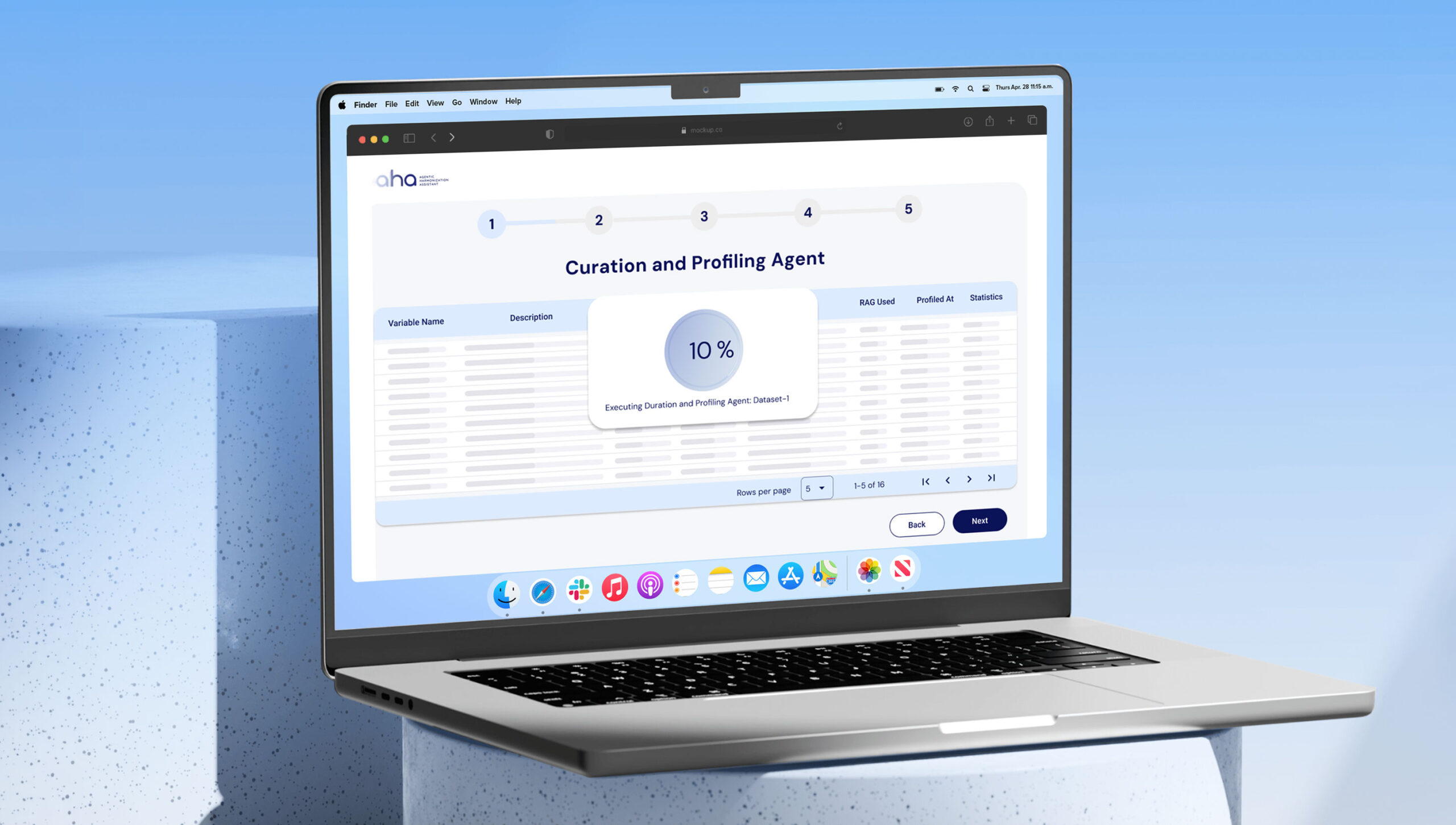
Strategy & Planning
Collaborative agents design a harmonization plan for each variable, proposing mappings, transformation steps, confidence scores, and approval flags. These plans are iteratively refined through a proposer–critic–refiner workflow before execution.
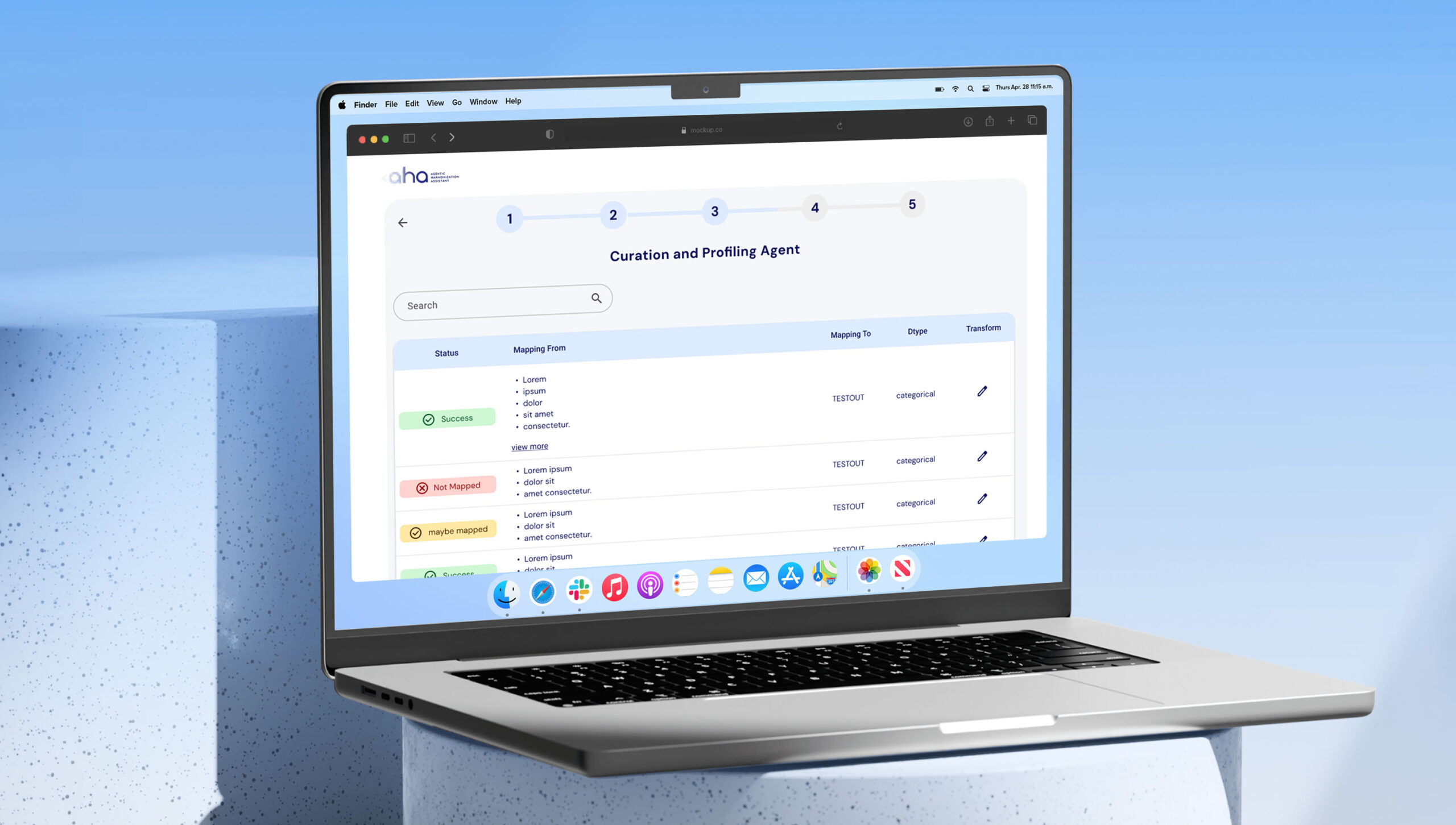
Execution
Once the plan is approved, aha™ applies a library of transformations to harmonize the data. These transformations include recoding values, aligning formats, merging columns, and standardizing text to generate a dataset that follows the selected harmonization standard.
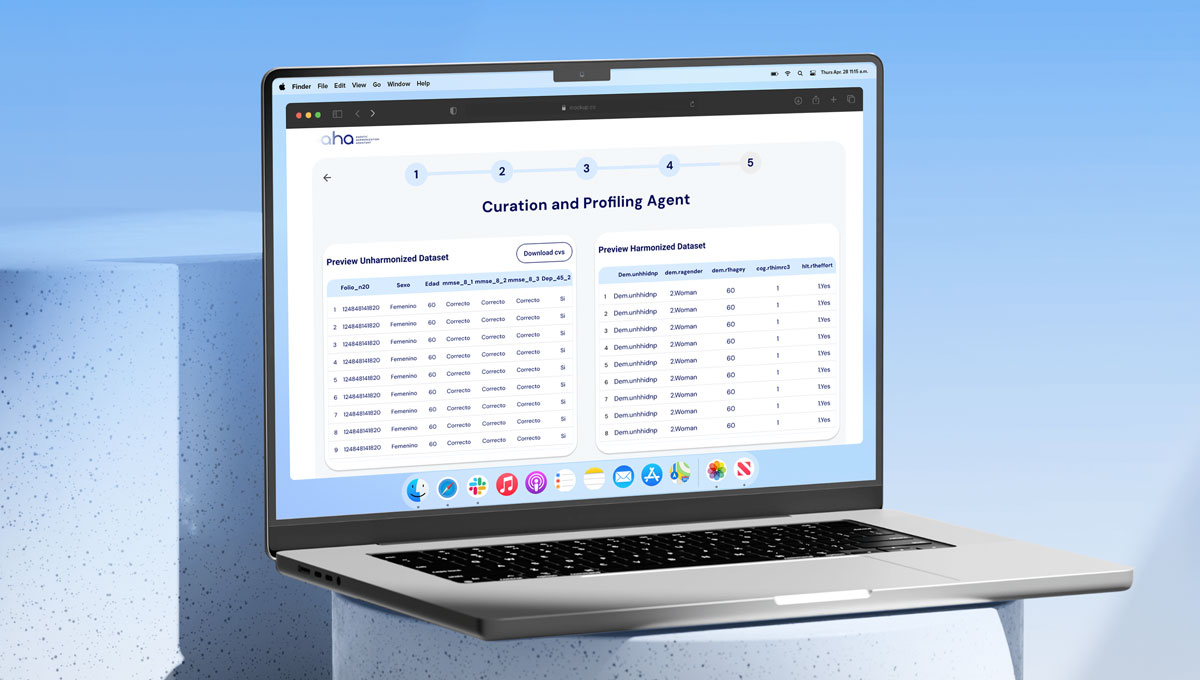
Validation
Compares the harmonized dataset against the defined standard and the original source profiles, computing summary statistics and verifying each planned transformation. The system flags discrepancies and generates per-variable validation tables, ensuring the final dataset is transparent, traceable, and ready for high-stakes AI modeling.
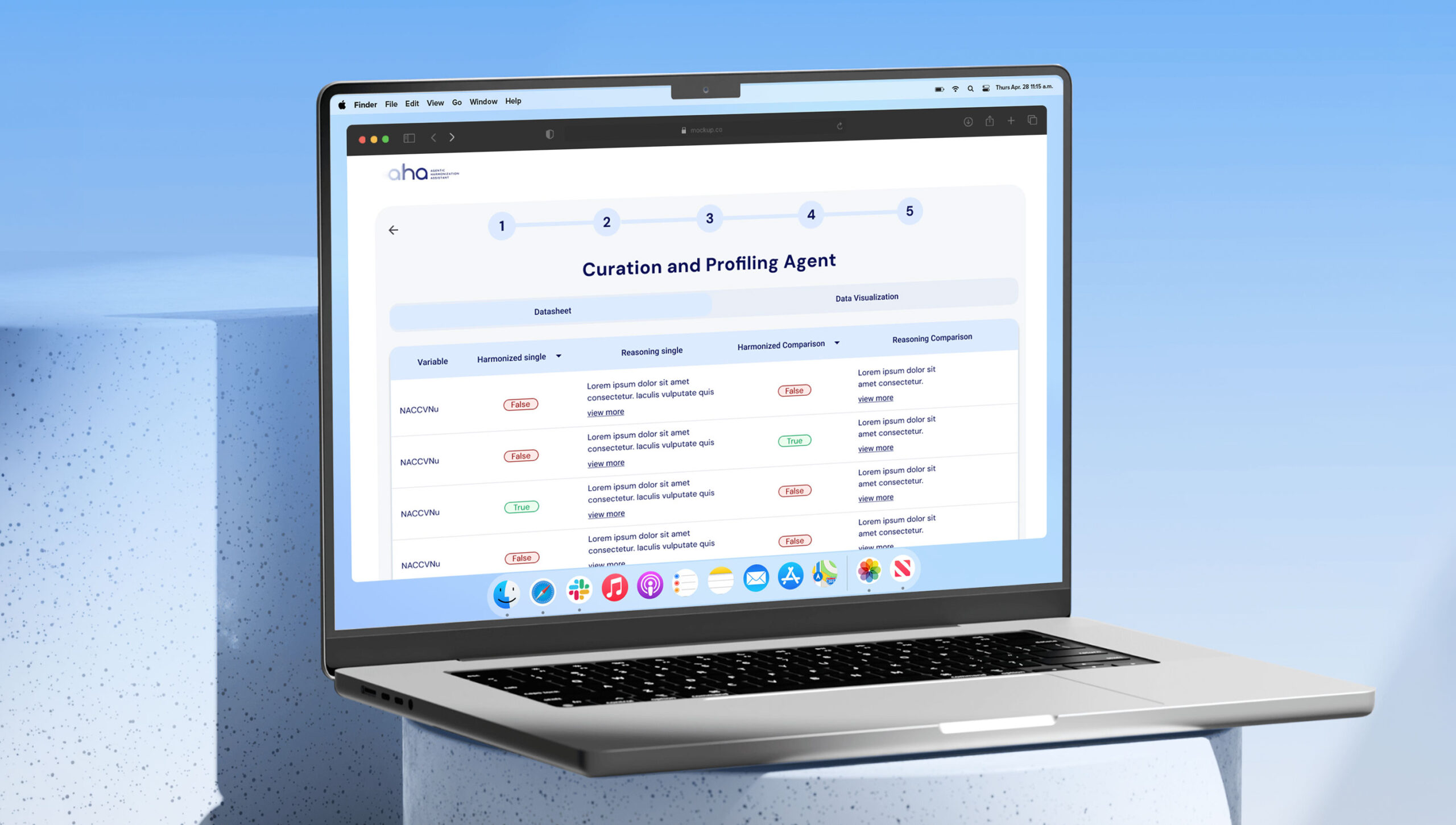
From the first upload to final validation, aha™ makes data harmonization collaborative, explainable, and repeatable—transforming weeks of manual effort into a guided workflow that can be reused whenever a new cohort arrives.
Traceable decisions
Every mapping, rule, and transformation is stored in an auditable plan, giving data teams and clinicians full visibility into how each variable was harmonized.
Ready for large‑scale studies
Harmonized datasets make it easier to combine cohorts, run cross-site analyses, and support multi-center AD/ADRD research with consistent variables.
Built for real‑world data
aha™ is designed for heterogeneous clinical records, neuroimaging, multi-omics, and sociodemographic datasets.
Discover MINT-AD™
MINT-AD™ leverages decades of international research in aging, genomics, clinical practice, and cognitive science to support AI-driven clinical decision making in Alzheimer’s disease.